
Here at the coop, we’ve recently appointed Rob Topham, to implement and head up a new diversity programme for 2022 and beyond. We have already hit the ground running, by adding pronouns to our email signatures, and later this month hosting a masterclass with the Taylor Bennett Foundation.
Another change however is the introduction of bi-monthly diversity blogs; these will be written by various members of the agency and used as an informative way to educate the team, and anyone else interested in learning more, on a variety of topics, advancements and news relating to all things diversity.
For our first blog, and to coincide with LGBTQ+ History Month, Rob has looked at why we celebrate all things LGBTQ+ in February, where the idea for the landmark comes from, and progress in recent years.
Firstly, I’d like to begin by clarifying that while February is LGBTQ+ History Month in the UK, the actual month of celebration differs per country.
In the US, October is the month chosen, this is to coincide with National Coming Out Day, and to commemorate the 1979 march on Washington for gay rights.
In the Netherlands, often referred to as the ‘birthplace of gay rights’, the month is celebrated in August to coincide with local pride events.
Finally, our Berlin office will be celebrating in May, where the month is known as ‘Queer History Month’.
As such, it’s clear to see that each celebration is personal to the nation itself, and so relates to its own laws, customs, and culture. That being said, there is too a shared culture, one that pervades nations and borders, a common-language and history shared between all LGBTQ+ people.
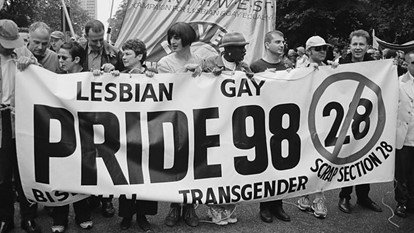
1998 protest at London Pride, image Credit: STEVE EASON/HULTON ARCHIVE/GETTY IMAGES
The UK’s celebration of the month in February coincides specifically with the abolition of Section 28, in 2003. To put it lightly, Section 28 was a rather horrible little law that existed to actively stop “promoting the teaching of the acceptability of homosexuality as a pretended family relationship”.
This in effect ensured the lives of LGBTQ+ people were considered taboo at best and criminalised at worst. Any research, protest, or advancements, scientific or cultural, done to improve the lives of LGBTQ+ people were prohibited. As such, the eventual abolition of Section 28 set the stage for LGBTQ+ History Month, a time where schools and institutions could begin educating people as to the lives, histories and struggles of LGBTQ+ people, thus paving the way for the tolerance, acceptance, and eventual embracement of LGBTQ+ people in society.
Something I for one, as a gay man, am pleased about, because without this abolishment I couldn’t fill my days in the office teaching my colleagues the difference between ‘asexual’ and ‘intersex’ and educating on completely legitimate terms such as ‘hetty hell’ and ‘BGNO’, (Big Gay Night Out).

The Stonewall Inn, site of the 1969 Stonewall Riots
Thanks to this ‘embracement’ the necessity for things such as LGBTQ+ History Month, in addition to global pride events, is often called into question. Those calling these events into question however potentially fail to consider the lives of queer people, which have for all modern times been on a rapid trajectory of learning, understanding and growth, both internally (the individual), and externally (the wider world’s opinions and acceptances).
As such, the terms that encapsulate LGBTQ+ are constantly growing and shifting, for, five years ago the definition of LGBTQ+ would have been drastically altered from the understanding and definition we have today. As such, the term ‘LGBT’ can at times feel exclusionary, thus ‘LGBTQ+’ has been adopted more in 2022, to recognise the lengths we all still have to go, and will always have to go, in understanding one another’s difference- I’m looking at you, Putin.
The month then is less about ‘gay history’ as it may once have been, but rather a way to celebrate progress of all those from a diverse background regarding their sexuality. For now, early history covers predominantly events such as the AIDS epidemic and Stonewall riots, however as we move further and further through time, the histories of various people will be documented and celebrated more and more, increasing the canon of what we consider ‘LGBTQ+ history’.
In light of this, I thought it best to round-off these words by discussing a few of last year’s developments in the LGBTQ+ world.

Josh Cavello, by Attitude
Firstly, it was announced that the 2021 census, and those moving forward, will now have an additional question based around one’s gender identity. The question, “Is the gender you identify with the same as your sex registered at birth?”, has been added to further recognise and improve the lives of trans and non-binary people, and an excellent step in improving awareness to the whole of the UK.
In addition, there are now a record number of people ‘out’ as LGBTQ+ in a number of diverse fields. From the spicy Josh Cavello, the first ‘openly gay top-tier men’s footballer’ to actress Emma Corrin, and country music star TJ Osbourne.

Kylie Sonique Love, Winner of Rupaul’s Drag Race All Stars S6
Finally, something we here at the coop are incredibly pleased about, the media coverage of the lives and culture of LGBTQ+ people has never been more mainstream. From Russell T Davies’ ‘It’s a Sin’ proving to be a huge hit, to cult LGBTQ+ shows like RuPaul’s Drag Race not only going mainstream but also crowning its first-ever transgender winner in queen Kylie Sonique Love.

