
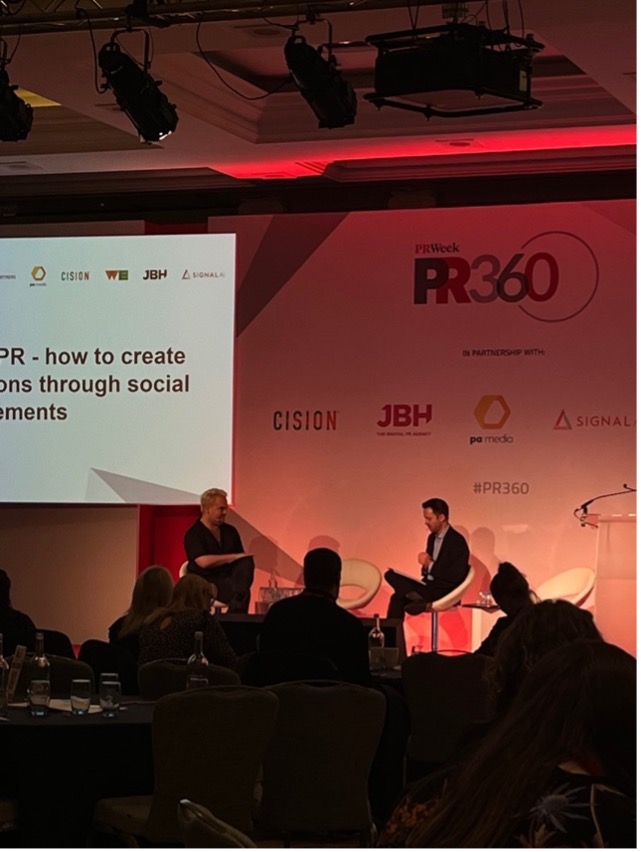
Members of the coop recently headed (further) south for a few days in Brighton. While our trip may have featured sun, sea, and stones (poor old pebble beach), we were really there for conferences and collaborations at PR Week‘s PR360 event.
With the PR industry growing by 20 per cent in the UK, and 18 per cent globally, there have been huge changes over the last two years. Always keen to go back to school, we’ve pulled together our top five key learnings from the event.
 Brighton lacking sand
- Brands need to both say and do the right thing (ESG, have selves in check before communicating a message)
News outlets are on the frontline of driving societal change but where do the writers get their materials? PR teams. Brands should be doing the right thing first and foremost.
PR Week’s research suggests 58 per cent of people buy based on a brand’s ethics, 89 per cent said these should be communicated more, and
70 per cent stated if a brand doesn’t communicate its sustainability credentials, they assume this is because they don’t have any. If a brand wants to tackle an issue and communicate this, statistics and cast iron (or should that be recycled aluminium?) proof are essential.
What a brand does is more important than what a brand says. Regardless of how well PRs communicate a story, there needs to be depth and responsible authenticity behind it. We live in a cynical society, so trusted voices and influential figures are a must to communicate any ‘do good’ stories. This doesn’t mean selecting a celebrity a brand believes aligns and paying them to promote it, but allowing the figure to interpret the initiative, form an authentic opinion and share it in their own words.
2. The pitching process has evolved and continues to
The Public Relations and Communications Association’s recent survey found that 30 per cent of PRs feel the pitching process with prospective clients is broken.
However, there’s an argument to say it isn’t broken, it has just evolved. While a straightforward press office was once enough, brands now request an array of marketing skills to be at an agency’s fingertips, ideally blending them together.
As we all know, our world is remoulded by things becoming more digital on a daily basis, throw in the catalyst of Covid and the pitching process has been entirely reshaped. The days of Googling for PR agencies are fading and the best way to now be considered by brands on the lookout is simply doing well to get your work noticed. Recommendations, social media exposure, longevity of clients and consistent extraordinary coverage now go beyond an agency’s day-to-day job and formulate its CV. For those looking for the proof in the pudding, we were recently approached by a brand after spotting a full-page for Smeg in The Sunday Times Style and researching who was behind this. Simply killing it every day for existing clients is the best route to attracting new ones.
3. Creative campaigns need to go beyond being crafted by a brand and a PR team
Nothing creates a buzzier atmosphere at the coop than a brainstorm after a client has asked for ‘creative ideas’ for a launch, anniversary, or product focus. However, these wide briefs need to be considered wider than just those within PR agencies or teams and a brand to avoid minds running wild and stepping away from a brief or brand’s key messages. Dare we say it, becoming “too creative”.
Journalists, influencers, wider marketing teams and even non-marketing teams all need to be brought onboard in the early stages to receive wider opinions. Finding out whether the concept makes sense, and communicates what you were aiming to, from those who don’t live and breathe the brand is imperative in clarifying whether the general public will have an understanding. Simple logistics that lead to success can also be established at this point. For example, understanding whether your target media’s journalists are happy to attend events post-Covid will make or break that genius in-person idea you had in mind.
A creative campaign must be culturally relevant, hooking onto a news story or seasonal event, for it to be communicated by the media. This may mean holding onto the idea for weeks, months or years but its impact at a key time will be tenfold. Keeping an eye on, and working with, those who determine this will make all the difference.
Agencies need to bring a fresh perspective but creative concepts must have a 360 approach.
4. The gap between PR and SEO is being bridged
With the cost of living on the rise, budgets squeezed, and spending habits changing, marketing managers are increasingly looking for commercial value from PR. As outlined in our recent blog, digital journalism is becoming increasingly shoppable so editorial coverage and SEO must be interlinked for this to work as hard as possible for publishing houses.
Product pages must constantly be optimised for digital coverage to impact brands. Therefore, PRs today must fully understand how media work and be looking out for how they manage editorial content to boost SEO. Both reactive and proactive PR is essential to nail this. Whilst newsjacking and jumping on a Google trend needs to often be reactive and turned around quickly, marketing teams can put themselves at an advantage by planning ahead. By creating narratives and anticipating trends to come, brands can create oven-ready media assets, ready to go as soon as a trend begins to creep up the SEO rankings. Not only will a brand’s e-commerce team thank the PR agency, but so will the journalist scratching around to get a story while it’s hot.
5. Success can be measured, ironically, in countless ways
Traditional PR is often measured by its readership and advertising value. The second can be particularly problematic, with editorial coverage having a higher weighting than advertising and rates fluctuating based on a host of variables. Clarity in circulation figures is essential too, with platforms, agencies and brands often calculating these differently.
With new means of media consumption comes new measurement metrics. PRs and brands are now able to measure coverage quality, referral traffic, keyword rankings, page rankings, social media shares – you name it. Drilling down into the ‘why’ of a brand’s objectives can assist in informing which metrics should be measured but this shouldn’t only be assessed by “the data person”. Looking at how this impacts different areas of a business and its future helps to create a holistic approach to PR – something that needs to come from both agency and brand-side.

